The Illusion of Human Review
We’ve been comforting ourselves with a dangerous lie.
When your resume gets rejected within minutes of submission, you tell yourself, “It’s just an automated machine filter. Once a real human hiring manager looks at my projects, they’ll understand my actual engineering capabilities.”
In 2026, that human savior no longer exists.
A groundbreaking large-scale study published by researchers at the University of Washington exposed a terrifying psychological phenomenon known as The Algorithmic Mirror. The study proved that when human recruiters use AI screening co-pilots, they don’t critically evaluate the machine's choices. Instead, they suffer from extreme automation bias—blindly mirroring the AI’s sorting criteria and implicit filters over 90% of the time.
If the machine ranks you low because of a structural formatting quirk, the human reviewer's brain subconsciously code-switches to view you as unqualified. The machine creates the reality; the human just signs the rejection slip.
The Math Behind 'Systemic Rejection'
To understand why this is killing your placement chances, you have to look at the enterprise hiring architecture of 2026. Over 90% of mid-to-large technology firms have centralized their screening by routing applications through the exact same handful of third-party Natural Language Processing (NLP) engines.
This has created an Algorithmic Monoculture. If your resume contains a single structural layout bug that causes one vendor's parser to break, you don't just fail a single application. You trigger a systemic blackout across the entire market.
When the machine reads your file as scrambled data, it assigns a low match score. The recruiter opens their AI dashboard, sees your profile marked in red, and due to The Algorithmic Mirror, spends less than 0.5 seconds clicking "Reject."
1. The Strategy of 'Semantic Cleanliness'
To survive a hiring system where humans act like mirrors to algorithms, your document must achieve absolute Semantic Cleanliness.
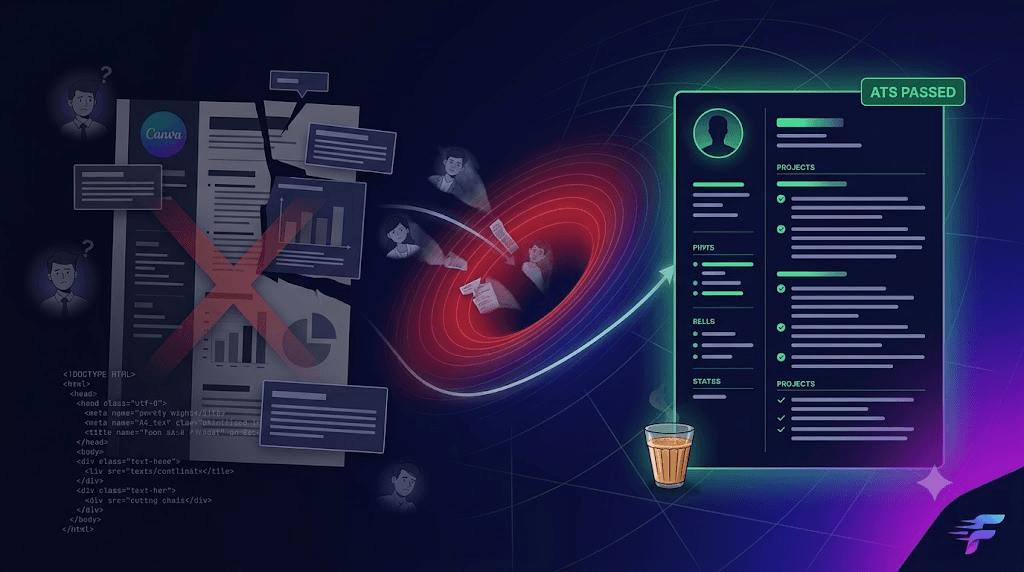
A common trap for Indian freshers during placement season is using highly stylized multi-column templates from Canva or complex floating tables in Microsoft Word. While these look beautiful to human eyes, NLP parsers read them line-by-line from left to right across the entire page geometry.
| Outdated Layout (The Canva Trap) | Modern Standard (The ATS 2.0 Safe Pass) |
| Multi-column grids that segment text | Strict single-column linear text flow |
| Graphical skill bars and rating scales | Raw, quantified text metrics and tool keywords |
| Floating text boxes and decorative asset icons | Clean typographical markdown structure without tables |
When a multi-column layout is parsed sequentially, your project descriptions bleed into your education dates, generating unreadable HTML garbage on the recruiter's backend dashboard. Shift to a parser-first structure to ensure the machine reads your experience flawlessly.
2. Overcoming 'Loss Aversion' in Project Metrics
Psychologically, recruiters looking at a high volume of profiles suffer from acute Loss Aversion. They aren't looking for reasons to hire you; they are actively hunting for a single signal to safely eliminate you and reduce their cognitive stack.
If your project blocks look generic, the recruiter's brain instantly categorizes you into the "theoretical tutorials crowd." You must bypass this bias by structuring your technical bullet points around economic maturity and optimization rather than raw syntax.
By shifting from "what it is" to "how efficiently it runs," you feed the NLP engine the high-density contextual keywords it requires to rank your profile in the green zone.
3. The 'Rule of Three' for Technical Clustered Profiles
When the AI screening co-pilot indexes your resume, it maps your skills into multi-axis vectors. If you list 30 different programming languages, databases, and frameworks in an attempt to look "well-rounded," the machine's keyword density model flags your profile as noisy and low-signal.
Limit your cognitive load using Skill Clusters anchored around the psychological Rule of Three. Group your tools into highly specific, high-impact subsets that project deep, specialized authority:
How FitMyCV Breaks the Mirror
Most students fail their active placement waves because they are writing documents for a human hiring manager who will never see them. You are writing for the machine first, and the human second.
At FitMyCV, we engineered our platform to reverse-engineer this exact automated gatekeeper. Our 27+ Parameter Deep ATS 2.0 Audit scans your resume line-by-line using the identical NLP parsing configurations deployed by enterprise vendors. We flag hidden layout bugs, missing job-description keywords, and structural breaks before you hit submit.
With our native A4 Auto-Alignment engine, you can completely escape Microsoft Word margin hell and spacing roulette. Your resume renders pixel-perfect into a standard single-column, highly parser-compliant structure automatically.
Stop throwing your career into an algorithmic black hole. Run a clean Clutter Audit, optimize your layout in the time it takes to drink a hot cup of cutting chai, and make the machine work for you.
Claim your 30 free credits instantly upon signup at https://fitmycv.site. No credit card required, no hidden subscription traps—just absolute semantic cleanliness.