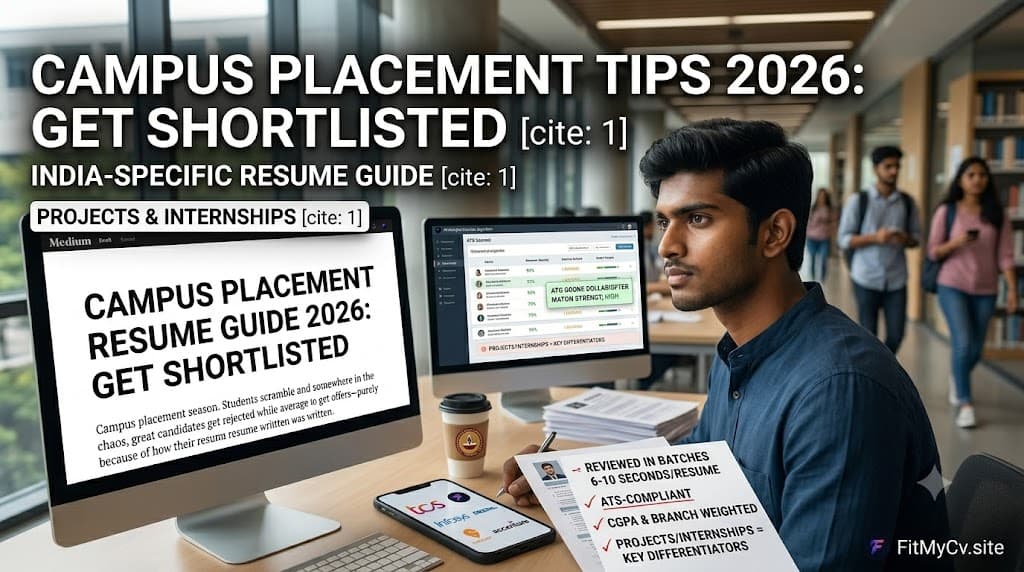
Campus placement season. The most stressful 3 months of a student's life.
Companies arrive with slots. Students scramble. And somewhere in the chaos, great candidates get rejected while average ones get offers - purely because of how their resume was written.
I spent 3 years coordinating campus placements at a top engineering college. I've seen what works and what doesn't. This is everything I wish students knew before placement season starts.
The Campus Placement Resume vs Regular Job Application Resume
There's a fundamental difference between a campus placement resume and a regular job application:
Campus placement resume:
- Reviewed by company HR in batches of 200-500 resumes in a single day
- Shortlisting decision made in 6-10 seconds per resume
- Often passed through ATS before human review (especially for large drives - TCS, Infosys, Accenture)
- CGPA, branch, and college name carry more weight
- Projects and internships are your primary differentiators
Regular job application resume:
- More time for review but higher competition
- ATS filter is even more important
- Work experience matters more, academics matter less
Your campus resume needs to be instantly scannable and specifically optimized for fast batch review.
The 1-Page Rule for Campus Placements
One page. Non-negotiable for campus placements.
Recruiters reviewing 400 resumes in a day will not read page 2. If it's not on page 1, it doesn't exist. Everything that matters - your best project, your best internship, your key skills - must fit on page 1.
If you can't fit everything on one page, you're including too much. Prioritize ruthlessly: pick your top 2-3 projects, your most relevant skills, and your highest-impact experiences.
Section-by-Section Breakdown for Campus Placement
Header Section
Name (large, center), B.Tech/B.E. in [Branch] | [College Name] | [Graduation Year], CGPA: X.XX/10, Phone | Email | LinkedIn | GitHub
Include CGPA prominently - companies explicitly filter by CGPA threshold (most require 6.0+, premium companies require 7.5+, some require 8.0+). If your CGPA meets their threshold, make sure it's instantly visible.
Technical Skills
Put this second - before experience, before projects. Campus recruiters often scan skills first to see if you qualify for a technical role.
Format:
Languages: C++, Python, Java, JavaScript
Web Technologies: React.js, Node.js, HTML/CSS
Databases: MySQL, MongoDB
Tools: Git, VS Code, Postman, Docker (basics)
Projects (Your Crown Jewels)
For freshers, 2-3 well-described projects are worth more than a dozen generic bullet points.
Project description formula:
[Project Name] | [Technologies Used] | [GitHub Link]
[1 line: What you built and why]
[1-2 lines: Key technical decisions and scale]
[1 line: Outcome or learning]
Example:
SmartPath - AI Career Recommender | Python, Flask, React.js, scikit-learn | [GitHub]
Built a career path recommendation system using collaborative filtering on 10,000+ LinkedIn profiles dataset.
Achieved 78% recommendation accuracy; deployed on Heroku with 200+ beta users during college tech fest.
Reduced manual counseling session load by 40% in a pilot with our college career cell.
That project description would stand out in any campus placement batch.
Internship Experience
Even a 1-month internship counts enormously during campus placements. Companies see internship experience as proof you can function in a professional environment.
What to include:
- Company name, role, duration (Month Year - Month Year)
- 2-3 bullet points with: what you built + technology used + outcome
- Mention if it was a live project vs training project
What not to include:
- "I learned a lot during this internship" - says nothing
- "I worked with a team to develop features" - too vague
- "I was responsible for front-end development" - too passive
Academic Projects / College Labs
If you don't have an internship, academic projects fill that gap. Treat them like real projects - describe the technology, scale, and outcome.
Mini-projects from coursework count. Hackathon submissions count. Open source contributions count. College technical club projects count.
Certifications
AWS, Google Cloud, Microsoft Azure, Cisco CCNA, NPTEL, Coursera specializations - list them with the issuing platform and year. Many campus recruiters specifically look for cloud certifications for tech roles in 2026.
Achievements
Hackathon wins, competitive programming ranks (CodeChef, Codeforces, LeetCode), college rank, scholarships, sports captain, cultural secretary - include 2-3 that show something distinct about you.
Company-Specific Tips for Campus Placement 2026
TCS (National Qualifier Test route):
TCS NQT results matter more than your resume for initial shortlisting. But your resume determines which role you're considered for. Include Java, SQL, and SDLC keywords prominently. CGPA must be clearly stated - TCS has a 6.0 minimum.
Infosys:
Infosys campus drives focus heavily on coding ability in early rounds. But your resume must show: Java or Python, basic data structures, and any cloud exposure. Infosys has been pushing cloud adoption hard - AWS/Azure exposure is a differentiator.
Wipro:
Wipro WILP (Work Integrated Learning Program) values candidates who show learning ability. Include certifications and online courses. Show you invest in self-learning.
Accenture:
Accenture campus drives look for well-rounded candidates. Include both technical skills and soft skills indicators: leadership roles, event organization, team projects.
Tech Startups and Product Companies (dream companies):
These companies visit fewer campuses but come for quality over quantity. They want candidates who've actually built something that works. Your GitHub profile matters as much as your resume. Have live projects with READMEs.
The ATS Factor in Campus Placements
Larger companies running campus drives at scale use ATS to pre-screen even campus applicants. TCS, Infosys, Accenture - all use some form of automated screening for the initial cut.
This means: your campus resume must also be ATS-friendly.
- No tables or columns
- No graphics or Canva formatting
- Standard section headers
- Keyword-matched to the specific role
Check your campus resume's ATS score before placement season starts. Fixing it early costs you 15 minutes. Missing the shortlist costs you the entire company.
FitMyCV gives you a 0-100 ATS score, shows exactly what's wrong, and fixes it automatically. Specifically built for Indian freshers and campus placements - understands B.Tech, MBA, CGPA, 10th/12th format, and Indian company requirements.
30 free credits on signup. No card needed. Start at fitmycv.site before your placement season begins.