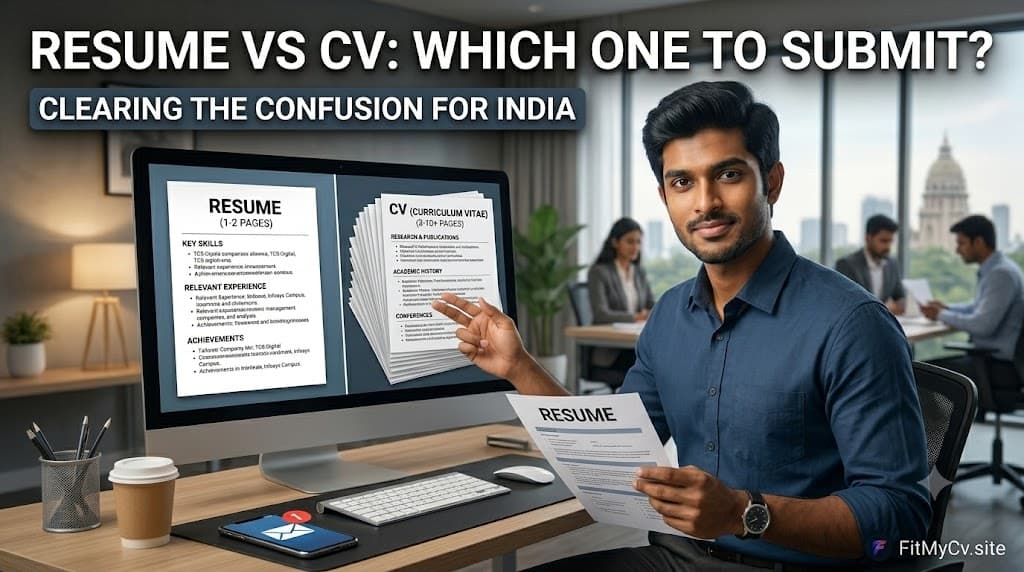
"Please send your CV" says the job posting. You send your 4-page document. The recruiter opens it and immediately loses interest.
Or the opposite - you send a 1-page resume to a research institution asking for a CV and get rejected for "insufficient detail."
The resume vs CV confusion in India costs thousands of candidates interviews every year. This guide ends the confusion once and for all.
Resume vs CV - The Actual Difference
Resume:
- 1-2 pages maximum
- Tailored specifically to the job you're applying for
- Focuses on relevant skills, experience, and achievements
- Used for: corporate jobs, startups, MNCs, IT companies, business roles
CV (Curriculum Vitae):
- 3-10+ pages (length grows with experience and publications)
- Comprehensive document covering your entire academic and professional history
- Includes: research, publications, presentations, awards, conferences
- Used for: academic positions, research roles, government jobs (UPSC, PSU), international applications
What Indian Companies Actually Want
Here's the practical reality for 2026:
IT and Tech Companies (TCS, Infosys, Wipro, Flipkart, etc.):
Want a resume. 1-2 pages. Clean, ATS-friendly, tailored to the role. They process thousands of applications - nobody reads 4 pages.
Startups and Product Companies:
Want a resume. 1 page preferred, 2 pages maximum. They want to see what you've built and what impact you've had. Nothing else.
MNCs (Google, Microsoft, Amazon, Deloitte, etc.):
Want a resume. These companies use ATS heavily. A long CV will confuse the parser and lower your score.
Government Jobs (PSUs, UPSC, State Government):
Want a biodata or CV. These often have specific formats provided by the hiring authority. Follow their format exactly.
Academic and Research Institutions (IITs, IIMs, CSIR, DRDO):
Want a CV. Full academic history, publications, research experience, conferences attended.
International Applications:
Depends entirely on the country. US/Canada/Australia = Resume. Europe/UK = CV. Academic positions worldwide = CV.
The Indian "Biodata" - A Third Format to Know
In India, especially for non-tech roles and certain industries, recruiters ask for a "biodata." This is a uniquely Indian format that falls between a resume and CV and sometimes includes personal details (date of birth, marital status, languages known, references) that would be inappropriate in a Western resume.
Biodata is increasingly outdated but still requested in:
- Manufacturing and industrial companies
- Family-owned businesses
- Traditional sectors (banking old guard, government contractors)
- Certain regional job markets
What Format to Use - The 2026 Decision Tree
Use a 1-page Resume if:
- You're a fresher or have under 3 years of experience
- Applying to any tech, startup, or product company
- Applying through Naukri, LinkedIn, or company career portals
Use a 2-page Resume if:
- You have 3-8 years of experience
- You have multiple relevant roles to showcase
- The job is at a corporate MNC or consulting firm
Use a CV if:
- Applying to academic, research, or government institutions
- Applying internationally to Europe or UK companies
- You have publications, patents, or conference presentations to list
Use a Biodata if:
- The job posting specifically asks for biodata
- Applying to traditional Indian businesses or non-corporate roles
ATS and Format - The Hidden Variable
Here's what most resume-vs-CV guides don't tell you: regardless of which format you choose, it needs to pass ATS.
A beautifully designed 2-page resume full of tables and graphics will score lower on ATS than a plain-looking 1-page resume with proper formatting and keywords.
Before you submit any document, check its ATS score. FitMyCV gives you a 0-100 ATS readiness score and shows exactly what's wrong. 30 free credits, no card needed - fitmycv.site.