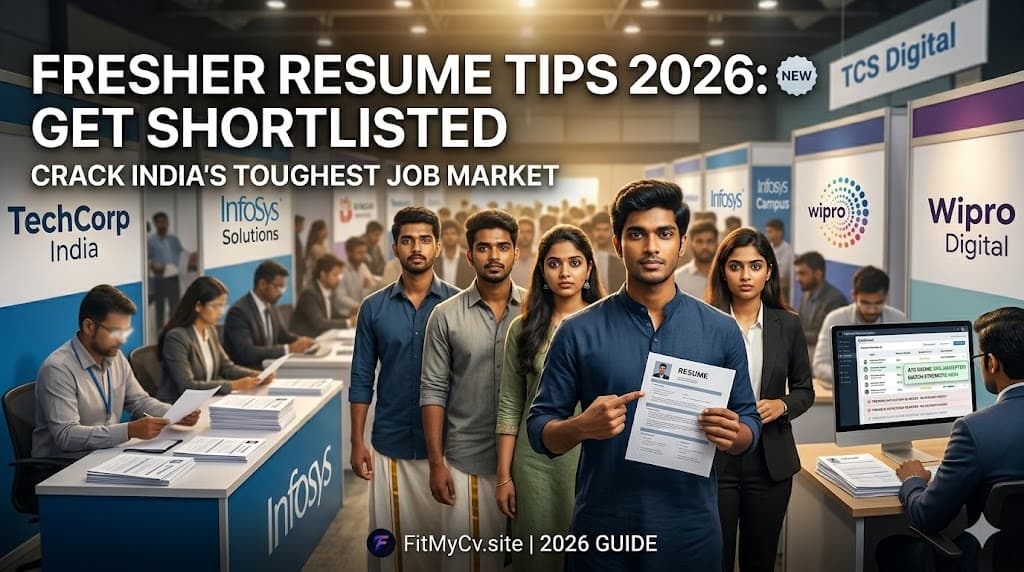
You just graduated. You have a CGPA, some projects, maybe an internship - and 500 other candidates who look exactly like you on paper.
Here's the honest truth: most fresher resumes fail not because the candidate lacks skills, but because the resume is written the wrong way. This guide will change that.
Why Fresher Resumes Fail ATS in India
The fresher resume challenge in India is unique. You're competing for roles at TCS, Infosys, Wipro, Cognizant, and hundreds of startups simultaneously. Each has different ATS systems, different keyword requirements, and different scoring criteria.
The average Indian fresher makes these critical mistakes:
The CGPA-First Resume
Putting CGPA at the top and listing it as your main selling point signals to ATS and humans alike that you have nothing else to show. Your CGPA should be present but not your headline.
The Template Resume
Using the exact same Naukri or college placement cell template as 10,000 other candidates means your resume looks identical to everyone else's. ATS systems see the same patterns and score you against a sea of similar profiles.
The "Familiar with" Trap
Writing "Familiar with Java" or "Basic knowledge of Python" is the kiss of death. Either you know it enough to use it in a project or don't list it. ATS systems score "proficient in Python" higher than "basic knowledge of Python."
The Fresher Resume Formula That Works in 2026
Section 1: Header
Name (large, bold), Phone, Email, LinkedIn URL, GitHub URL (if tech role), City.
Do not include date of birth, photograph, gender, or religion - these are outdated and can actually trigger bias-prevention filters in modern ATS.
Section 2: Professional Summary (3 lines)
This is where most freshers waste prime ATS real estate with generic lines. Instead, write a targeted summary:
Weak: "Motivated B.Tech graduate seeking challenging role in software development."
Strong: "Full Stack Developer with hands-on experience in React.js, Node.js, and MongoDB through 3 project builds. Contributed to open-source projects with 200+ GitHub stars. Seeking backend engineering role at a product-focused company."
The second version has keywords, specifics, and a clear value proposition.
Section 3: Skills
This section alone can make or break your ATS score. Structure it clearly:
Programming Languages: Python, Java, JavaScript, C++
Frameworks & Libraries: React.js, Node.js, Django, Spring Boot
Databases: MySQL, MongoDB, PostgreSQL
Tools & Platforms: Git, Docker, AWS, Jira, Postman
Concepts: REST APIs, Data Structures, OOP, Agile, CI/CD
Never put skills in a paragraph. Always use a structured list. ATS systems parse structured skill lists far more accurately.
Section 4: Projects (Your Most Important Section)
As a fresher, projects ARE your experience. Treat each project like a job entry.
Weak project description:
"Built an e-commerce website using React"
Strong project description:
"Developed a full-stack e-commerce platform using React.js, Node.js, and MongoDB serving 500+ test users. Implemented JWT authentication, Razorpay payment gateway integration, and responsive design reducing mobile bounce rate by 35%."
See the difference? Technologies, scale, and outcome. Every project needs all three.
Section 5: Internship / Experience
Even a 1-month internship counts. Even a college project for a local NGO counts. The key is quantifying everything.
"Interned at [Company] and worked on features" - scores low.
"Developed 4 REST API endpoints at [Company] reducing data fetch time by 28%, used by 3 internal teams" - scores high.
Section 6: Education
B.Tech / B.E. / MCA / MBA - list your degree, college, year, and CGPA/percentage. Also list your 12th and 10th with board and percentage. Indian ATS systems for entry-level roles specifically look for 10th and 12th data.
Section 7: Certifications
AWS, Google, Microsoft, Coursera, NPTEL - add any relevant certifications. These are strong keyword triggers for tech roles.
Campus Placement Specific Tips
For TCS iON / TCS NQT:
TCS uses a structured scoring system. Your resume needs: CGPA above 6.0 (clearly stated), no active backlogs, skills matching their specific role requirements (listed on their careers page), and projects that show hands-on coding.
For Infosys InfyTQ:
Infosys looks for learning agility. Show certifications, online courses completed, and any exposure to new technologies. Their ATS rewards demonstrated learning.
For Wipro WILP / NLTH:
Wipro's campus recruitment ATS scores heavily on programming languages and tools. Make sure your skills section exactly matches what their JD lists.
For Startups and Product Companies:
These use third-party ATS (Greenhouse, Lever, Workable). Be even more precise about tailoring keywords to each JD. Startup ATS systems have smaller applicant pools but stricter scoring thresholds.
The One Thing That Will Double Your Shortlist Rate
Tailor your resume for every single application. Yes, every one.
It sounds exhausting, but here's the reality: a tailored resume takes 5 minutes with AI. An untailored resume wastes 5 months of job searching.
FitMyCV lets you paste the job description and automatically rewrites your resume to match - keywords, bullet structure, skills section - everything. 30 free credits on signup. No card needed. fitmycv.site